
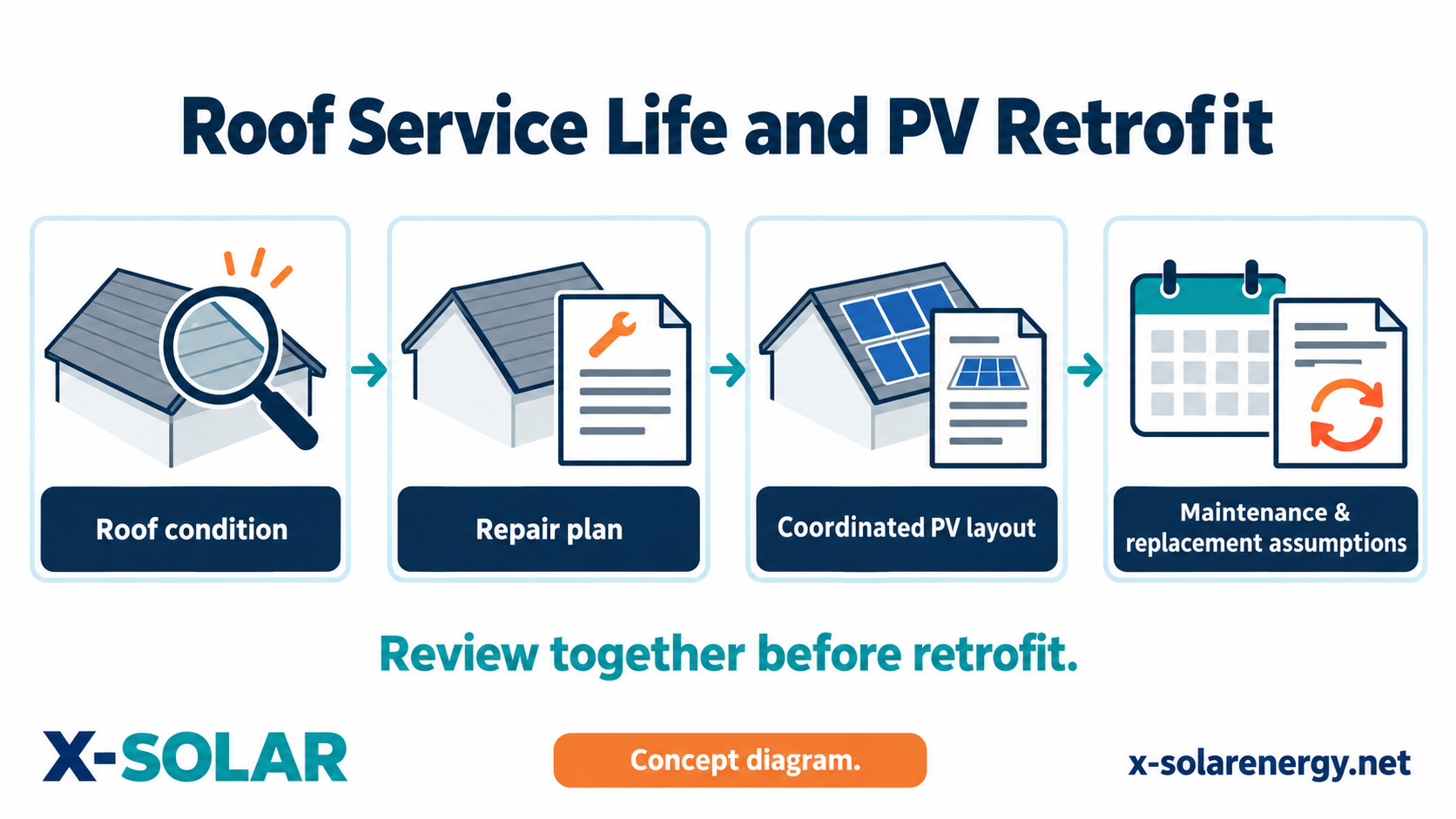
Direct answer: Review the roof's condition and planned maintenance before fixing the PV retrofit sequence. Record which repairs precede installation, which later interventions could affect the array, and who confirms access, removal and reinstatement requirements. Carry the resulting downtime and replacement assumptions into the energy estimate. Roof age, module weight and a first-year generation figure cannot establish the roof's remaining service period.
Start with a roof decision, not a universal lifetime
Ask the building owner and appointed roof reviewer for the current condition assessment, repair history and planned work. Identify the roof covering, supporting construction, drainage and relevant attachment interfaces. Separate observed condition from an assumed assessment period: a commercial analysis period is not evidence that the roof will remain suitable for that long.
Record the assessment date, covered areas, limitations and conditions that trigger another review. Keep manufacturer warranty documents separate from the condition assessment. Where evidence is incomplete, leave the affected decision open and assign the missing information to a named project party.
Compare the sequence before choosing it
A practical review can compare repair before PV, a phased installation across released areas, and installation with a documented later roof intervention. These are discussion scenarios, not instructions to install on an unassessed roof.
- Repair first: identify the work and the records needed before the affected roof area is released for PV design or installation.
- Phase the work: show the roof zones, temporary interfaces and separate release decisions; do not assume one zone's acceptance covers the rest.
- Plan later intervention: ask how access, electrical isolation, protection, removal, storage, inspection and recommissioning will be addressed by the responsible specialists. Reuse of a removed module or attachment must not be assumed.
Use the exact product and roof instructions to resolve interfaces. A generic sequence does not supply a removal procedure, adhesive compatibility decision or reinstatement acceptance.
A roof and PV coordination record to complete
Copy this register into the project brief. Enter document references and responsible parties; the prompts do not mean the work has already been checked.
| Decision | Evidence or input to record | Required project response |
|---|---|---|
| Roof condition | Survey date, roof/building IDs, affected areas, defects, limitations and report revision. | Identify who confirms the assessed scope and any further investigation. |
| Repair sequence | Roof work scope, affected PV areas, dependencies and release records. | State repair first, phased work or a documented later intervention; record unresolved conditions. |
| Future intervention | Roof access, equipment interfaces, exact manufacturer documents and proposed responsibility split. | Identify who confirms removal/reinstatement feasibility and the evidence required after the work. |
| Outage assumption | Affected part of the array, proposed period, reason, source and uncertainty. | Give the energy modeller the same scenario used by the roof and construction team. |
| Change control | Current drawings, model files, file revisions, open questions and decision owner. | Reissue the affected layout and estimate when the agreed baseline changes. |
Connect roof work to the energy-estimate inputs
Keep three quantities distinct: roof area describes geometry in square metres; installed capacity is a power rating in kilowatts; generated energy is measured or modelled over a period in kilowatt-hours. Record whether a capacity is DC or AC. Gross area does not establish the final layout, and a capacity rating alone does not determine annual energy.
The official PVWatts V8 reference identifies inputs including capacity, array type, tilt, azimuth, losses and a weather-data source. Its monthly and annual AC energy outputs are estimates for those inputs. Ask for the model/version, location, weather dataset, layout revision, capacity basis and loss assumptions behind the quoted result.
For a retrofit comparison, also record the assessment horizon, degradation treatment and planned roof-work scenarios. State whether an estimate represents an initial operating year or a longer-period assessment. Do not silently extend a first-year result over the full period or substitute a generic degradation assumption for the selected model's documented inputs.
Make downtime visible without counting it twice
The official SAM PVWatts system-design help treats availability losses as reductions associated with shutdown or other operating constraints. If roof work affects only part of an array, identify that scope. When its timing matters to the decision, request a calculation that resolves the affected periods rather than spreading annual generation evenly over calendar days.
Check whether the same outage is already represented in a general availability allowance before applying another reduction. Keep the baseline and intervention scenarios comparable. A representative weather file does not predict the weather on future construction dates: PVWatts' interpretation guidance distinguishes typical long-term weather from results for a particular month or year. Present uncertainty and exclusions with the result.
Questions for the project review
Does a lightweight module remove the need for roof repairs?
No. Low module mass does not establish watertightness, substrate condition or the suitability of the proposed attachment. The roof and project interfaces still need their own evidence.
Can the assessment horizon be treated as remaining roof life?
No. Record the chosen modelling period separately from the roof review's scope and conditions. Ask the responsible roof party to explain the basis for any remaining-service-period statement.
Is an energy estimate a generation guarantee?
No. The U.S. Department of Energy's modelling guidance describes uncertainty in observations, specifications and model assumptions. Record what was assessed and what remains provisional.
Documents to send with the enquiry
- Located roof drawings and photos, condition/repair records, planned roof works and reviewer contacts.
- The proposed PV layout, exact product/attachment documents, access requirements and responsibility boundaries.
- The energy-model input report, weather source, revision, loss assumptions and roof-work scenarios.
- Missing inputs, quotation exclusions and the decision requested from each project party.
Use the rooftop PV engineering brief to organize the pack, and the attachment review guide for interface questions. Send available documents through the X-SOLAR contact page.
Published by Beijing X-SOLAR Energy Co., Ltd. Content updated: 2026-10-27. This is a project coordination guide; it supplies no site-specific service-life, installation, energy-output or approval conclusion.
