

Direct answer: A PV mechanical test result applies to a defined specimen and test setup. Project design loads depend on the site, building, roof zones and attachment system. A test report can support a design review, but it does not by itself establish that a particular roof is suitable.
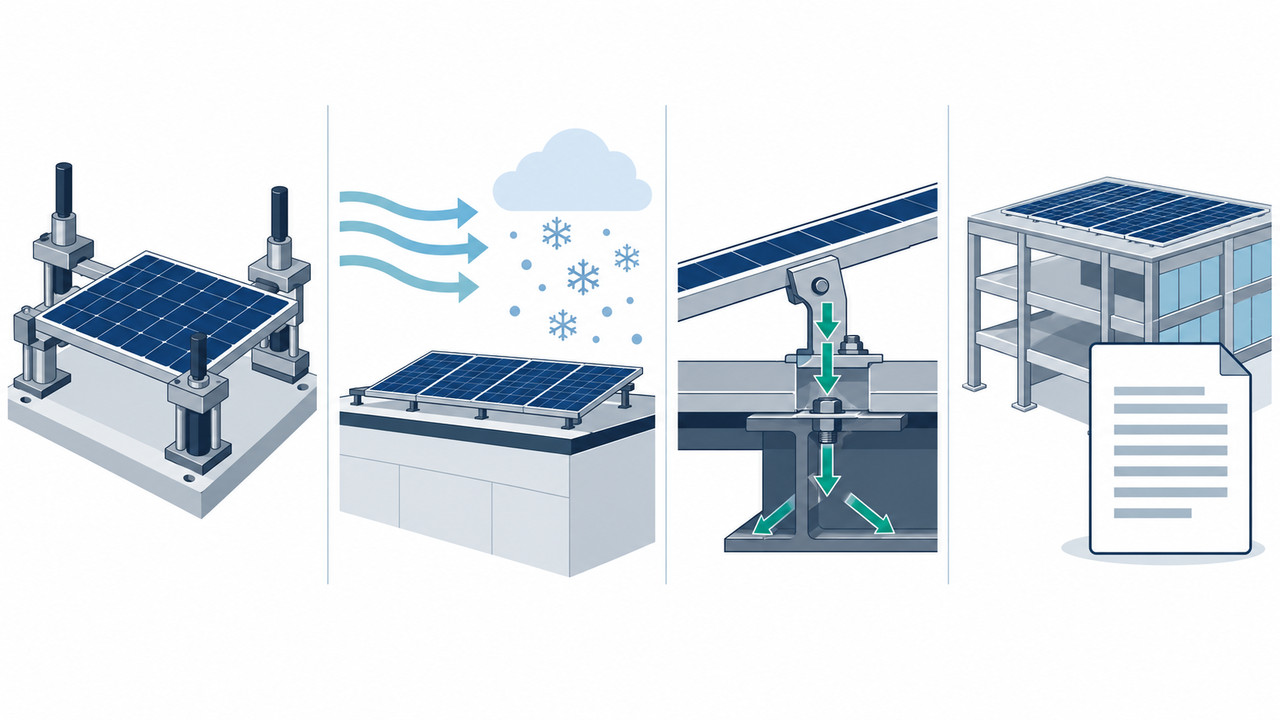
What does a mechanical test load describe?
Read the full report scope. Confirm the exact product model and configuration, specimen, support or fixture conditions, load direction, test procedure, acceptance criteria, and any stated limitations. The report may cover a module or a particular assembly; do not extend its result to a different configuration without evidence.
A test value is meaningful only with its method and boundary conditions. It should not be read as a universal allowable load for every roof or attachment.
What determines project design loads?
Project design loads are established for the actual location and building under the applicable local design basis. Depending on the project, the review may need to address wind pressure and uplift, snow, load combinations, building height and exposure, roof geometry, and edge or corner zones. The responsible project engineer should confirm which cases and assumptions apply; this article gives no design values.
Trace the attachment load path
Map how forces are transferred through the proposed system: module to adhesive, clamp, rail or other attachment; then through the roof covering or deck to purlins or other supporting members and the building structure. The actual interfaces depend on the selected system. Confirm substrate condition, attachment evidence, compatibility, and responsibility at every interface with the relevant suppliers and project engineer.
Practical evidence checklist
- Product match: exact model, suffix, configuration and the report annexes that cover it.
- Test boundary: specimen, fixture/supports, load direction, method, acceptance criteria and limitations.
- Project basis: site, building and roof information, applicable wind and snow cases, combinations, and zone assumptions.
- Load path: attachment details, substrate information, supporting-member layout and the evidence used for each interface.
- Structural review: the engineer's project-specific assessment, exclusions, open assumptions, revision and responsible party.
Review sequence before approval
- State the design question and identify the exact offered module and attachment configuration.
- Match the test report to that product and record any scope gaps.
- Set the project load basis for the location, building and roof; do not substitute a module test value for this step.
- Trace the full attachment path and have the responsible engineer review the existing structure and interfaces.
- Keep exclusions and unresolved inputs visible in the quotation and approval record.
Questions buyers often ask
Does a high mechanical test result prove that a roof is suitable?
No. It is evidence about the tested specimen and setup. Roof suitability also depends on site design loads, structural capacity, attachment details and the condition of the actual roof.
Does a lightweight module remove the need for wind and snow review?
No. Lower module mass can reduce one part of dead load, but it does not determine wind uplift, snow effects, attachment capacity or the roof's structural condition.
What should be sent for a preliminary review?
Send the project location, building height and use, roof material and profile, available drawings and condition photos, the proposed model and attachment method, the complete relevant test report, and any existing structural assessment. Mark unknowns clearly rather than estimating them.
Related X-SOLAR reading
For a project review request, include the available roof drawings, site location, roof photos, exact module model and configuration, attachment concept, relevant test documents and the questions that remain open. X-SOLAR can use the information to discuss product documentation and scope; project-specific structural approval remains with the appointed qualified engineer.
A review record the project team can complete
| Review field | Test evidence | Project input to match | Responsibility / open item |
|---|---|---|---|
| Product and construction | Report number, exact model, BOM and annex | Offered model, construction drawing and revision | Record the product-document owner and any mismatch. |
| Support and load direction | Specimen, fixtures, attachment and loading cases | Actual roof zones and full attachment path | Assign the responsible designer; identify unverified interfaces. |
| Load basis | Method, test condition and acceptance criteria | Site design basis, wind/snow cases and combinations | Project engineer to define applicable inputs; leave unknowns explicit. |
| Review outcome | Report limitations and applicable scope | Design revision, assumptions and exclusions | Record decision, reviewer, date and evidence needed before approval. |
Content maintained by Beijing X-SOLAR Energy Co., Ltd. (X-SOLAR) | Content updated: 2026-10-24
